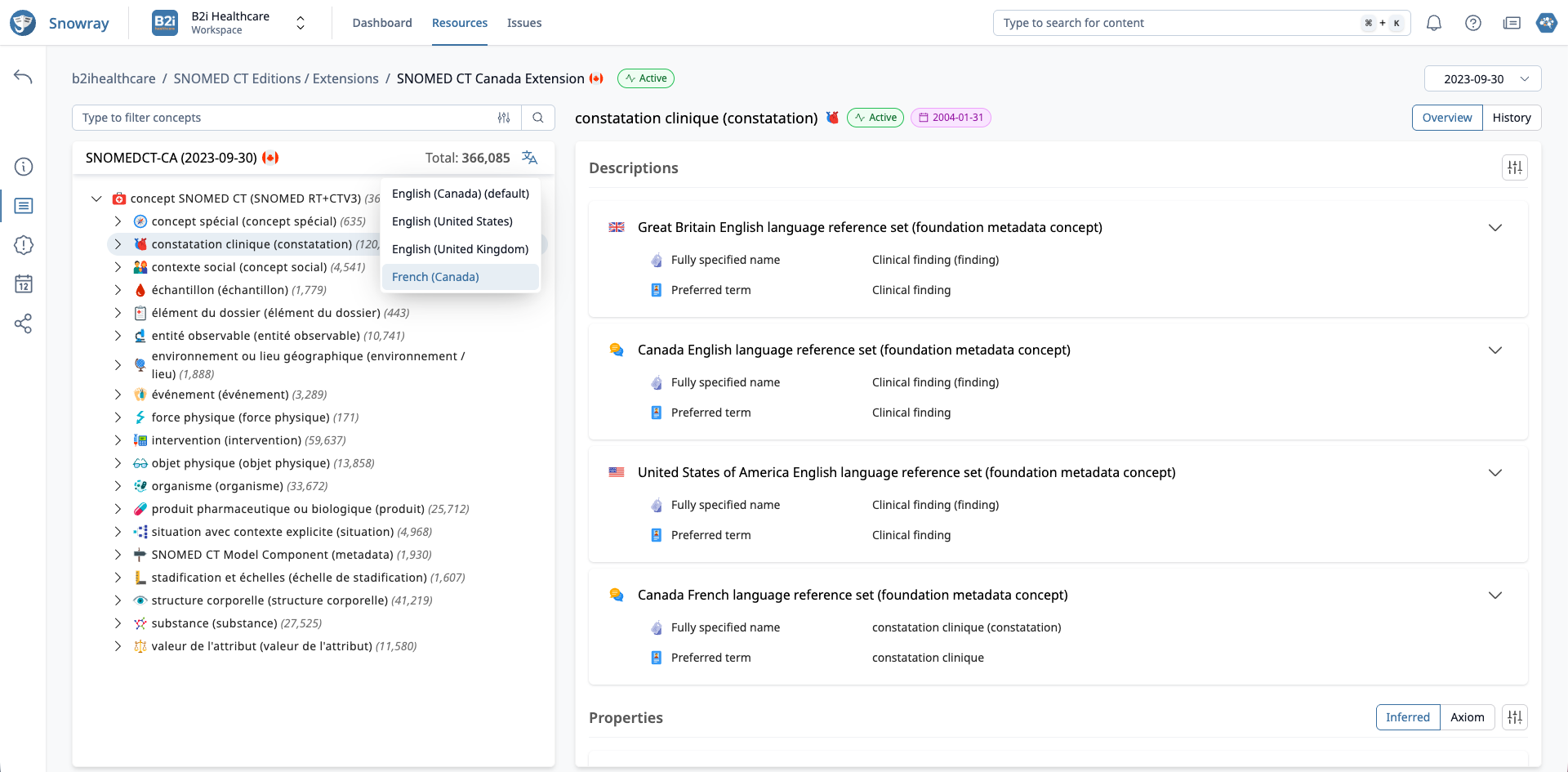
SNOMED CT Canada Extension with French language selected
 icon, and select the corresponding option from the menu.
{% endhint %}
In addition to the filter search, Snowray also provides an advanced search option for certain Code Systems ([SNOMED CT](/snowray/reference/resources/codesystems/terminology-standards/snomed-ct/search.md) and Custom Code Systems).
## Concepts
When browsing a Code System, selecting a [concept](#concepts) navigates users to the concept details. On the concept's ***Overview*** tab descriptions, properties, and metadata are revealed. Some of the content is displayed in blue color, which indicates that it is a link to another concept. Clicking on those links navigates users to the linked concept's detailed overview.

{% hint style="info" %}
Concepts are read-only components and can be browsed only within a Code System.
{% endhint %}
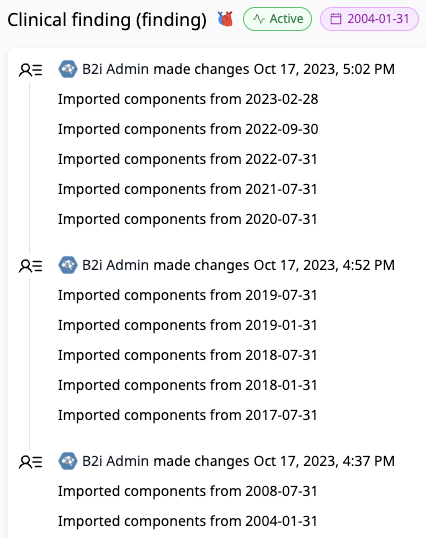
The concept's ***History*** tab displays the changes made to the selected [concept](#concepts). Each change is represented on a timeline and has an individual node. In their title, the nodes display the name of the user who did the modification and the elapsed time since the change, while the action that modified the concept can be found in the details part.
icon, and select the corresponding option from the menu.
{% endhint %}
In addition to the filter search, Snowray also provides an advanced search option for certain Code Systems ([SNOMED CT](/snowray/reference/resources/codesystems/terminology-standards/snomed-ct/search.md) and Custom Code Systems).
## Concepts
When browsing a Code System, selecting a [concept](#concepts) navigates users to the concept details. On the concept's ***Overview*** tab descriptions, properties, and metadata are revealed. Some of the content is displayed in blue color, which indicates that it is a link to another concept. Clicking on those links navigates users to the linked concept's detailed overview.

{% hint style="info" %}
Concepts are read-only components and can be browsed only within a Code System.
{% endhint %}
The concept's ***History*** tab displays the changes made to the selected [concept](#concepts). Each change is represented on a timeline and has an individual node. In their title, the nodes display the name of the user who did the modification and the elapsed time since the change, while the action that modified the concept can be found in the details part.
 ## Quick Link
Snowray's quick link feature enables users to take a look at specific concepts of a Code System without interrupting their browsing or searching flow.
When hovering over concepts in the terminology tree, the
## Quick Link
Snowray's quick link feature enables users to take a look at specific concepts of a Code System without interrupting their browsing or searching flow.
When hovering over concepts in the terminology tree, the  icon representing the *Open in new tab* option will appear.
{% hint style="info" %}
If you press , you will be taken to a new browser tab with the selected concept opened in the given Code System's ***Content*** tab.
{% endhint %}
## Language selector
The
icon representing the *Open in new tab* option will appear.
{% hint style="info" %}
If you press , you will be taken to a new browser tab with the selected concept opened in the given Code System's ***Content*** tab.
{% endhint %}
## Language selector
The  icon displayed in the terminology tree header enables changing the display language in case of terminologies with multiple translations.
{% hint style="info" %}
The icon is displayed only when language selection is applicable to a given terminology.
Currently, the feature is supported for SNOMED CT National Extensions and the Unified Medical Language System (UMLS).
{% endhint %}
{% hint style="info" %}
To see the available languages, click on the icon. The alternatives will be displayed in a dropdown.
{% endhint %}
icon displayed in the terminology tree header enables changing the display language in case of terminologies with multiple translations.
{% hint style="info" %}
The icon is displayed only when language selection is applicable to a given terminology.
Currently, the feature is supported for SNOMED CT National Extensions and the Unified Medical Language System (UMLS).
{% endhint %}
{% hint style="info" %}
To see the available languages, click on the icon. The alternatives will be displayed in a dropdown.
{% endhint %}
SNOMED CT Canada Extension with French language selected
icon will turn blue, indicating that you are browsing content in another language.
{% endhint %}
{% hint style="info" %}
If a translation is not available for a given term, it will be displayed in the default language.
{% endhint %}
The language selector is accessible from the terminology tree, therefore, users can also change the display language of the terminology tree content when referenced in other resources, i.e. when serving as domains for Value Sets and Concept Maps.